ISO 27001 Certification India -
ISMS Implementation
Everything you need to understand the international information security management standard — and how Dravincon helps you achieve certification.
Quick Summary: ISO 27001 Certification & Implementation
ISO 27001:2022 is the global standard for Information Security Management Systems (ISMS). Dravincon provides end-to-end consulting for achieving certification, covering all 93 controls (Organizational, People, Physical, and Technological). Our 7-step journey includes gap assessment, policy documentation, internal audits, and final certification support. An ISO 27001 certified ISMS is a primary requirement for demonstrating data security for DPDPA and global regulatory compliance.
The Global Standard for Information Security
ISO/IEC 27001 is the world's leading international standard for information security management systems (ISMS). It specifies requirements for establishing, implementing, maintaining, and continuously improving an ISMS.
The standard helps organisations of any size manage the security of assets such as financial information, intellectual property, employee data, and information entrusted by third parties.
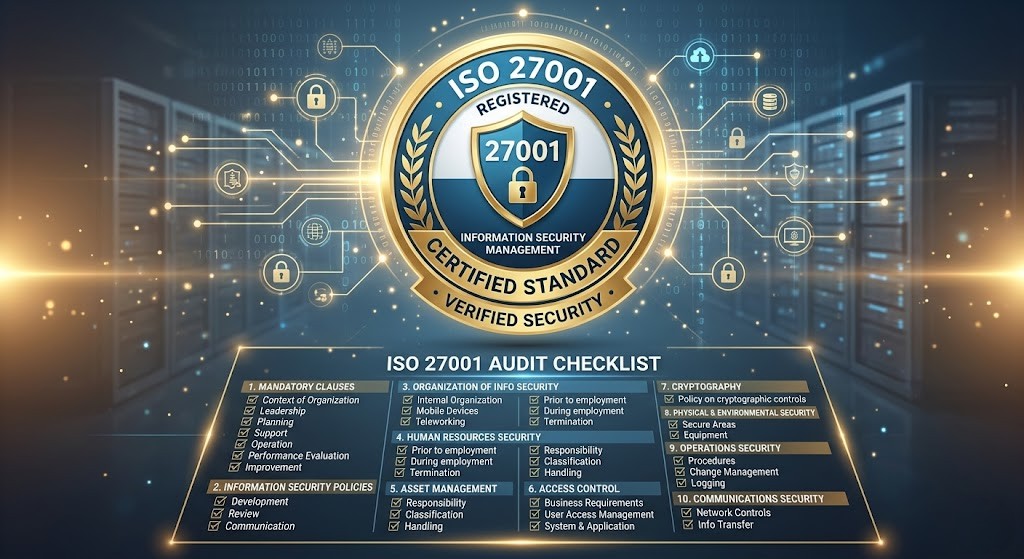
The ISO 27001:2022 Certification Journey
Dravincon's comprehensive 7-step roadmap to achieving international security excellence.
Identify the scope, assets, and existing security posture against 93 controls.
- Boundary & Scope Definition
- Detailed Gap Report (AS-IS vs TO-BE)
- Risk Management Methodology
Drafting the Statement of Applicability (SoA) and core security policies.
- Statement of Applicability (SoA)
- Security Policy Hierarchy (Level 1-3)
- Business Continuity Plan (BCP)
Educating employees and implementing physical/technical controls.
- Staff Awareness Workshops
- Control Evidence Gathering
- Access Control & Asset Tagging
An objective review of implemented controls to ensure they are functioning.
- Mock Audit Simulation
- Non-Conformity (NC) Reporting
- Root Cause Analysis
Final meeting (MRM) to approve the system before external certification.
- MRM Minutes & Action items
- Resources Allocation Approval
- System Performance Review
Initial review by the certification body to verify documentation readiness.
- Documentation Review
- Scope Verification
- Readiness Report
The final onsite audit for formal certification and award of the ISO 27001 badge.
- Stage 2 Site Audit
- Closing Meeting
- ISO 27001 Certificate Issued
Mastering the 93 Controls (2022 Update)
The ISO 27001:2022 update consolidated the previous 114 controls into 93 modernized controls across four themes. This shift reflects the modern digital landscape, including cloud services and remote work.
Organizational (37)
Governance, policies, and third-party risk management.
People (8)
Screening, terms of employment, and security awareness.
Physical (14)
Perimeter security, equipment maintenance, and facility access.
Technological (34)
Encryption, network security, and secure coding practices.
New 2022 Attributes
The latest ISO 27001:2022 update introduces attributes for streamlined control categorization and management.
Defining ownership and categorization for all information assets within the organization's scope.
Technical controls for data at rest, in transit, and during processing to ensure CIA triad integrity.
Securing people and premises through screening, training, and robust physical access management.
The 10-Step ISMS Implementation Path
A structured approach to building a resilient security management system.
Leadership Buy-in
Securing executive commitment and defining the information security policy objectives.
Scope Definition
Determining which departments, locations, and assets are included in the ISMS boundary.
Risk Assessment
Identifying threats to your information assets and evaluating the likelihood and impact.
Risk Treatment Plan
Choosing which controls to implement to mitigate identified risks to acceptable levels.
SoA Development
Creating the Statement of Applicability to justify the inclusion or exclusion of Annex A controls.
Policy Hierarchy
Developing Level 1 (Manual), Level 2 (Policies), and Level 3 (Procedures) documentation.
Control Deployment
Implementing technical measures like encryption, MFA, SIEM, and physical access systems.
Awareness Training
Conducting workshops to ensure every employee understands their role in the ISMS.
Internal Audit
Objectively verifying the system's effectiveness and identifying gaps before the final audit.
Certification Audit
Final assessment by a third-party registrar (e.g., BSI, SGS, Intertek) for formal certification.
ISO 27001 vs. SOC 2: Which is Right for You?
A comparison of the two most common security frameworks for modern enterprises.
ISO 27001 Frequently Asked Questions
What is the "Statement of Applicability" (SoA)?
The SoA is a central document that lists all 93 controls from Annex A, identifies which ones are applicable to your organization, and provides a justification for those that are excluded.
How long does it take to get certified?
For a mid-sized organization, the journey typically takes 6 to 9 months. This includes the preparation phase, implementation of controls, and the two-stage external audit.
What is the difference between ISO 27001 and ISO 27002?
ISO 27001 is the standard that organizations get certified against; it contains the requirements for the ISMS. ISO 27002 is a supplementary guide that provides detailed recommendations on how to implement the controls listed in Annex A of 27001.
Is ISO 27001 mandatory for DPDPA compliance?
While not explicitly mandatory by law, having an ISO 27001 certified ISMS is the most widely accepted method to prove "reasonable security safeguards" required by the Digital Personal Data Protection Act (DPDPA) 2023.
Download Our Guide
Get our comprehensive roadmap for ISO 27001:2022 transition for enterprises.
View WhitepapersDPDPA Alignment
Learn how ISO 27001 helps you satisfy India's new data protection law.
Explore DPDPAServing Chandigarh, Mohali & Panchkula
Dravincon provides on-site cybersecurity, VAPT, and compliance consulting across the entire Tricity region from our local headquarters in Sector 16, Panchkula.
Chandigarh
Enterprise security, compliance audits, and local engineering support.
Mohali
VAPT, ISO 27001 readiness, and dedicated BPO/IT industry services.
Panchkula
On-premise infrastructure security, cloud setups, and rapid incident response.